
 Earlier project
Filtration and fertigation
Filters that keep emitters and nozzles open, on the drip zones of a garden as much as on a farm, and dosing equipment that feeds a crop through the irrigation water.
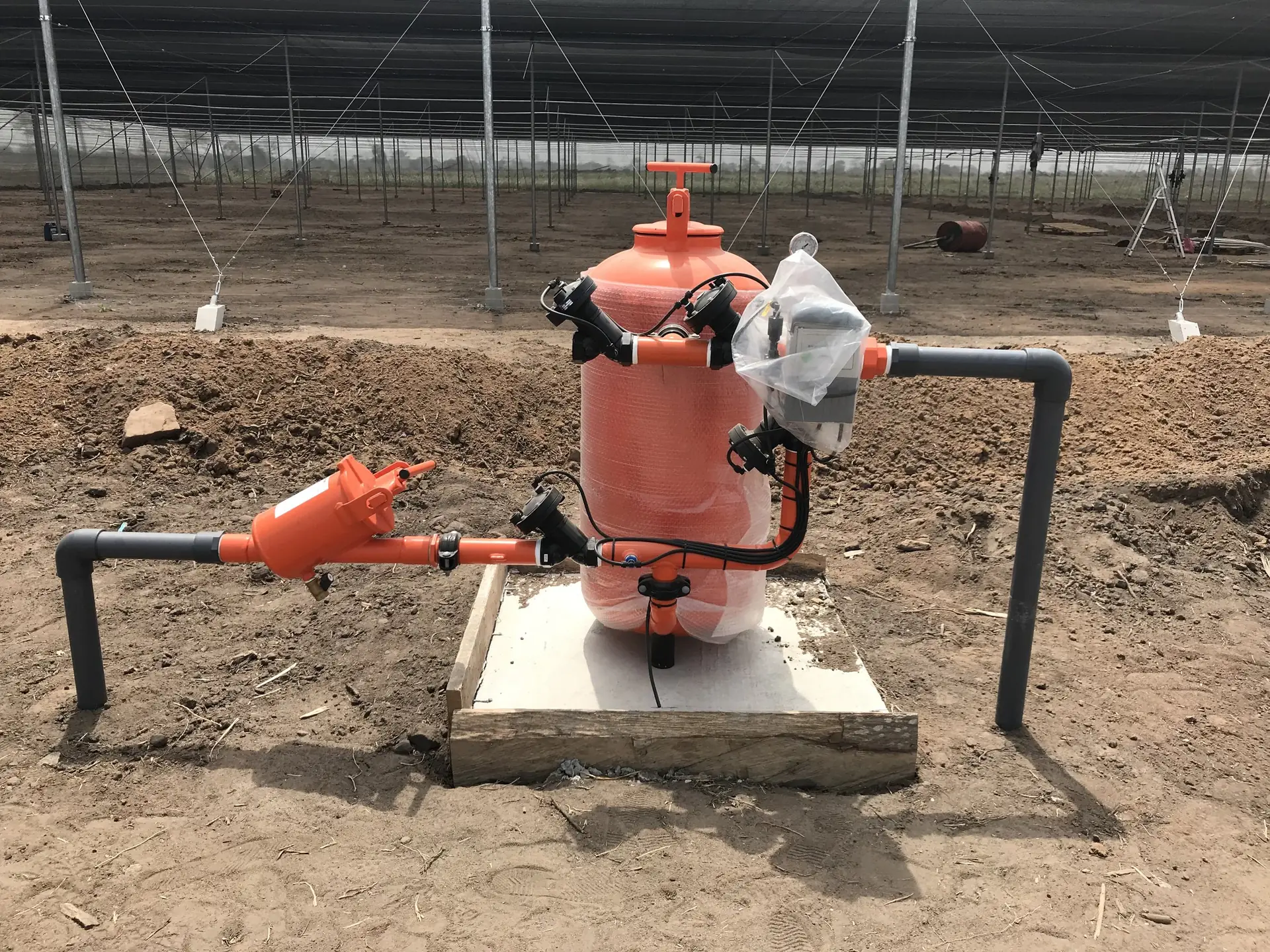
Fertigation at the head of the nethouse system.
- Pump
- Pressure gauge
- Non-return valve: stops fertiliser reaching the source
- Air valve
- Sand separator
- Media filters, in parallel
- Pressure gauge
- Injector on a bypass, with a throttling valve across it
- Fertiliser tank
- Disc filters, in parallel
- Pressure gauge
- Water meter
- Main valve
- Air valve
- Buried mainline
- Non-return valve
- Stops fertilised water running back to the source when the pump stops.
- Sand separator
- Spins heavy sand out of borehole water before it reaches the filters.
- Media filters
- Tanks of graded sand or gravel that catch algae and organic matter from rivers and reservoirs.
- Disc or screen filters
- A final fine filter, with a mesh matched to the emitters.
- Pressure gauges
- Before and after the filters. The difference between them shows when the filters need cleaning.
- Fertiliser tank
- Holds the dissolved nutrients for the next irrigation.
- Injector
- Draws the nutrients into the water after the media filters and before the final filter, in the amount the crop needs.
Why the water is filtered
- Water from the source, carrying sand, silt or algae
- The first filter, which catches most of it
- On a farm, a tank that feeds the crop through the water
- A fine filter, which catches the rest
- Clean water for the drip lines and sprinklers
- Drip zones in gardens and estates
- Drip systems on farms
- Crops under cover
- Water from rivers and reservoirs
- Borehole water carrying sand
What the design looks at
- The water: sand, silt, algae and anything else it carries.
- The size of the passages in the emitters or nozzles.
- The flow through the head at the largest zone or block.
- How the filters are cleaned, by hand or by automatic flushing.
- Where the water feeds a crop, its feeding plan through the season and the dosing rate.
For a landscape we design the system and supply the equipment; installation, commissioning and maintenance are quoted with it. For a farm we also install it, then start it up, check it and train the people who will run it.
Equipment we design with and supply: AZUD. Trademarks belong to their owners; no partnership is implied.
- Guide
Choosing a drip irrigation filter: screen, disc or media?
How to match a screen, disc or media filter to your water and your drippers, read a water test, clean the filter and allow for its pressure loss.
For farms, greenhouses, homes and estates - Guide
Drip irrigation and fertigation for greenhouses and nethouses.
What a greenhouse or nethouse fertigation unit needs: the parts, filtering, backflow protection, separate stock tanks, EC and pH checks, and setup steps.
For greenhouses - Guide
Irrigation maintenance through the season: a calendar of checks.
A calendar of checks for any irrigation system: what to look at each day, week and month, and the steps that start and end each season.
For farms, greenhouses, homes and estates
Drip irrigation
For planting beds, hedges and trees, and for row crops and orchards: water delivered at the roots.
Sprinklers, rotors and rain guns
For lawns and sports fields, and for field crops and pasture: wherever the whole surface needs water.
Centre pivot
For large, regular fields, with sprinklers and a control panel matched to the crop.
Irrigation traveler
A hose reel and gun cart that irrigate as they travel, for fields a fixed system does not fit.
Pumping
From a borehole, a tank, a river or a reservoir, sized to the water the source can give, solar where it suits.
Valves and automation
Controllers and automatic valves, so each zone gets its water at the right time.

your project.
Send the location, the area, the type of site and the water source. We call you to talk it through and, if the project needs it, arrange a site visit.